
-
Register Now for a Free Account!Unlock additional site access with your free account today, takes less than a minute, and guaranteed no spam - ever. Register Now!
National Geographic Endeavour #11 Oldest Active Cruise Ship - Cruising Earth
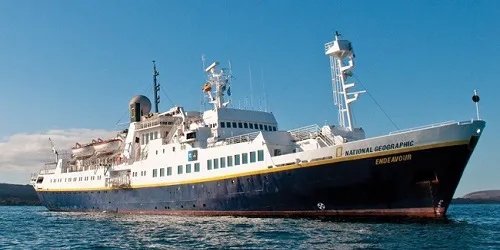
National Geographic Endeavour - Lindblad Expeditions (Nat Geo)
#11 Oldest Active Cruise Ship
National Geographic Endeavour Historical Brief
Introduction
The National Geographic Endeavour, a rugged and versatile expedition ship, is one of the most iconic small vessels in modern adventure cruising. Originally built in 1966 as a German fishing trawler, she underwent a complete transformation in the early 1980s to become a purpose-built passenger ship for remote and polar exploration. For more than two decades she sailed under the Lindblad Expeditions–National Geographic banner, carrying intrepid travelers to the Galápagos Islands, Antarctica, and other extraordinary destinations, combining scientific discovery with authentic expedition-style cruising.
Early Years: German Fishing Trawler (1966–1982)
Constructed in 1966 by AG Weser Werk Seebeck in Bremerhaven, Germany, the ship was launched as the MS Marburg, a sturdy stern trawler designed for commercial fishing in the harsh North Atlantic. For nearly two decades she operated as a hardworking fishing vessel, proving her strength and seaworthiness in some of the world’s most demanding waters. Her robust construction and ice-strengthened hull would later make her ideally suited for expedition cruising in polar and remote regions.
Conversion to Passenger Ship and Early Cruise Service (1982–2001)
In 1982–1983 the Marburg underwent a major conversion from a fishing trawler into a passenger vessel. She was renamed Lindmar, then North Star, and later Caledonian Star. Under these names she began offering expedition and adventure cruises, first with smaller operators and later with Noble Caledonia. Her compact size, shallow draft, and excellent maneuverability allowed her to access remote harbors and pristine wilderness areas that larger ships could not reach.
During this period she earned a reputation for reliable and adventurous voyages, including routes in the North Atlantic, Mediterranean, and beyond. In March 2001, while crossing the Drake Passage, she famously survived a massive 30-metre rogue wave — an event that highlighted her exceptional seaworthiness and became part of expedition lore.
National Geographic Partnership and Expedition Era (2001–Present)
In 2001 she was renamed Endeavour and joined the Lindblad Expeditions fleet. In 2005, following the partnership between Lindblad and National Geographic, she received her final and most famous name: National Geographic Endeavour. Under this banner she became a flagship for science-focused expedition cruising, carrying small groups of guests (typically around 100–170) along with naturalists, photographers, and National Geographic experts.
She specialized in the Galápagos Islands (one of her signature destinations), Antarctica, and other remote locales, offering Zodiac landings, kayaking, and immersive wildlife encounters. Multiple thoughtful refits kept her modern while preserving her classic expedition character and sturdy build.
Legacy and Cultural Significance
The National Geographic Endeavour stands as a remarkable example of maritime transformation and the spirit of exploration. From her origins as a hardworking German fishing trawler to her decades as a pioneering expedition ship, she helped define the modern era of small-ship, science-based adventure cruising. Her voyages introduced thousands of travelers to some of the planet’s most fragile and awe-inspiring ecosystems while advancing public understanding of conservation and natural history.
As one of the oldest active cruise ships still recognized in the expedition community, she represents the enduring appeal of authentic, low-impact travel aboard vessels with real character and history. Her legacy lives on in the many guests who experienced the world’s wild places in the most intimate and meaningful way possible — the true essence of National Geographic-style exploration at sea.